 Greetings everyone!
I am writing this huddled near the wood stove. It has been below freezing here for over three weeks straight and I’m looking at a foot of snow on the ground. What are our bees thinking? Keeping bees in Vermont for years and experiencing subzero temperatures for weeks taught me that cold does not kill bees in the Northeast. Mites vectoring viruses will weaken bees so they won’t winter over, though. Lack of food can cause them to starve. So now we are like the coach on the sidelines. We can’t step onto the field to help in these temperatures. The bees have to do this themselves.
But our team with their brown jerseys with black stripes comes armed with sixty million years of evolution. As the temperature drops they have learned to knit ever more tightly into a cluster with the outer bees forming an even tighter envelope around their sisters. By the muscular action of respiration and the flexing of wing muscles they are generating heat right now as we speak and their furry bodies are conserving it. They will keep the cluster at 70 degrees. And here comes the secret weapon. The trusty heater bees form on the comb surfaces and vibrate their abdomens rapidly generating more heat. Tiring after twenty seconds, they rotate out and other heater bees take their places. Way to go, heater bees!
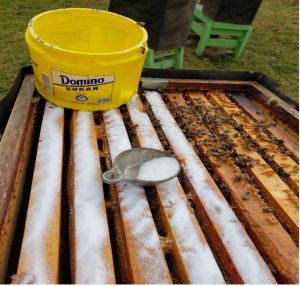
We are tempted to ignore all advice and open them up just to slip in a little fondant. Don’t do it! The thaw will come. The temperature will hit close to 50 and that’s your green light. But even then, don’t separate any boxes and crack the propolis seal they have made against the weather. By end of February the queen will have sensed the light change and will be laying eggs. Now the cluster has to work harder because the new young bees have to develop at 92 degrees. And this is when the honey begins to disappear fast because the adult bees have to eat more to create that heat and they have to also feed the young. No liquid feed yet, but a fondant will likely help them. There are many recipes online. Here’s one. https://www.honeybeesuite.com/how-to-make-fondant-from-table-sugar/ Or you can spread some white granulated sugar on the top bars as shown in the picture.
Keep watching our calendar! On Saturday, March 15 there will be a workshop on analyzing dead outs. And for our new Bee School members on Saturday, March 21 the workshop will be on hiving bees from the package to your actual wooden hive. That’s a good one to see!
All for now.
Andy Hatt, BYBA President